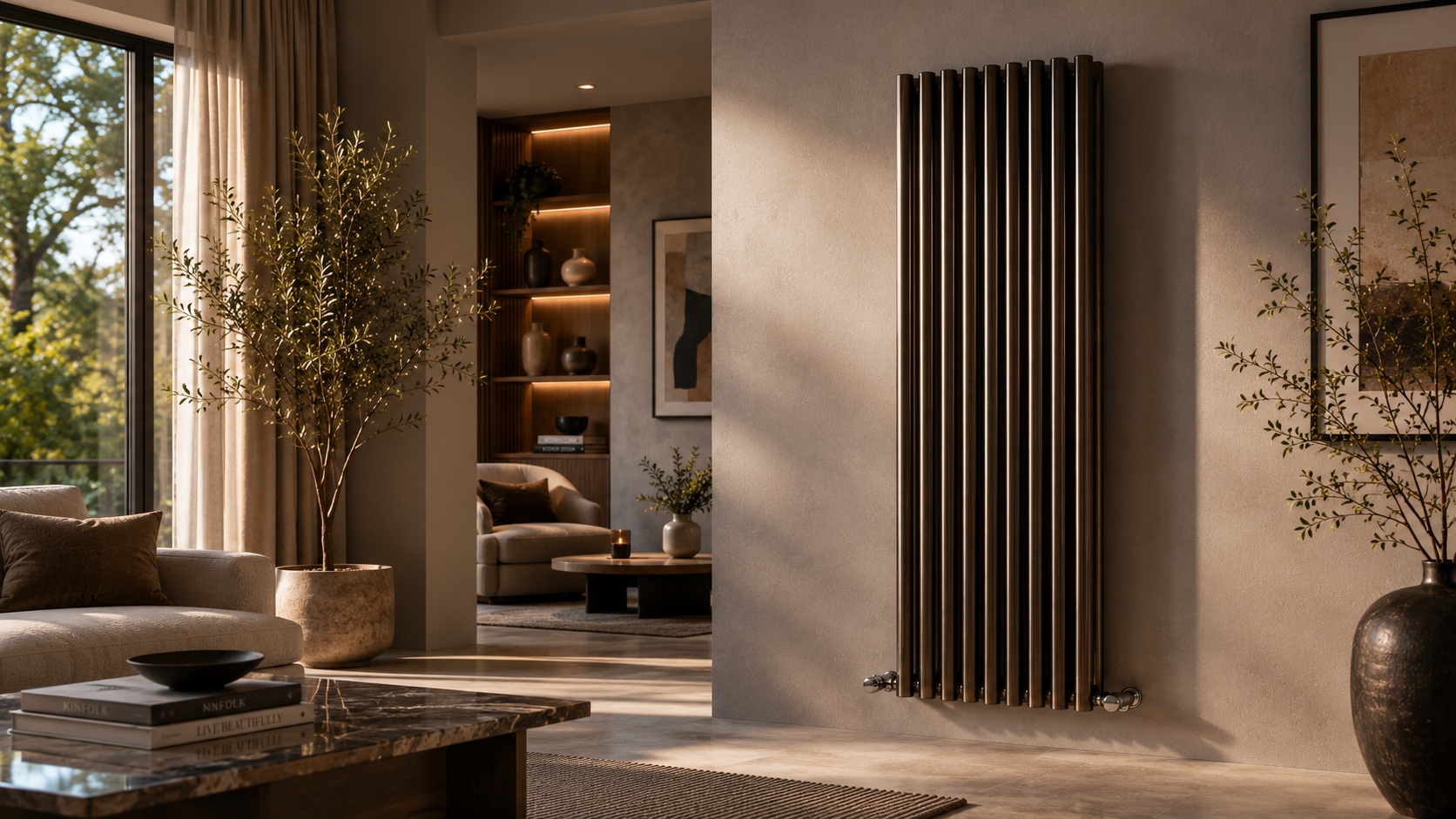
This guide concentrates on electric powered rails - An electric towel rail connects to your electricity supply only, it does not connect to your central heating.
Click to Jump To Question + Answer- How do I connect my electric towel rail?
- Who should connect my electric towel rail?
- Are there limitations to where I can fit my electric towel rail?
- What is actually included in a Geyser electric towel rail?
- Which side of the rail is the element fitted to?
- What type of heating solution is used?
- What are the benefits of buying single or variable heat options?
- Single heat option?
- Variable heat option?
- Heat output – understand how an electric rail works?
- Guarantee
- Understanding Chrome Plating
- Understanding Tube Diameter
- Understanding Quantity of Tubes
- Understanding Tube Profiles
- Understanding Vertical Profiles
- Understanding Rail Welding
- Understanding Brackets & Plugs
1. How do I connect my electric towel rail?2. Who should connect my electric towel rail?If fitted correctly and within the IEE wiring regulations, your electric towel rail will provide years of trouble free and safe use. However, without overstating the dangers, it is extremely important that a qualified electrician fits your towel rail. An incorrectly fitted electrical appliance can be lethal, especially in a bathroom environment where lots of water is found. Luxury hotels around the world have electric towel rails – proof that they are 100% safe if installed with safety in mind and by a qualified electrician.
3. Are there limitations to where I can fit my electric towel rail?Yes and the guidelines are covered in detail by the IEE wiring regulations 2005. Firstly, an electrical appliance fitted in a bathroom must have an appropriate IP rating (Ingress Protection) which is a measure of the protection against water infiltration. All Geyser electric towel rails are IP54 rated or higher which means that they can be fitted in Zones 2, 3 and 4. No electric towel rails are known to be manufactured by anyone for Zone 0 or Zone 1. The basis of the zonal areas is to prevent the electric towel rail falling or being pulled into a body of water or being subject in any way to water saturation. Here is a summary and illustration to help you understand the fundamental regulations…..
Zone 0:- The interior of the bath, shower or sink which can hold water
Zone 1:- The area directly above Zone 0 limited vertically to 2.25m above the bottom of the bath or shower.
Zone 2:-The area beyond zones 0 and 1, 0.6m horizontally and up to 2.25m vertically. Zone 2 also included any window with a sill next to the bath.
Zone 3:- The area beyond zones 2, 2.4m horizontally and up to 2.25m vertically. Zone 4:- Everything outside of zones 1-3. 
4. What is actually included in a Geyser electric towel rail?When you purchase a Geyser electrical towel rail you will receive the following…. 1. Towel rail pre-filled and sealed with heating solution. 2. Brackets for mounting the rail. 3. Electrical heating element (not installed – see below for good reasons why not) 4. Instructions 5. Substantial packaging so that the rail gets to you safely. 5. Which side of the rail is the element fitted to? The element is packaged with the towel rail but not actually connected into the towel rail. The main reason for this is so that you can choose which side you would like to have the element fitted to. Secondly, it puts the onus on the electrician to take responsibility for the safety of the towel rail – earthing and connections etc. The final reason is that we can protect the element more easily for transportation by packaging it separately. Screwing the element to the towel rail is very easy and easy to follow instructions are included.
6. What type of heating solution is used?Modern techniques mean that at Geyser we now use a water based heating solution. Previously oil was used but increased environmental concerns have led to the perfect substitute being adopted – water with additives. The additives are the most important element and we use the UK’s most respected glycol Fernox Protector™ and Fernox Noise Silencer™. This solution mix promotes a quieter operation, eliminates lime scale build up, prevents freezing of the radiator in winter and contains anti-corrosive properties. Beware! Many Geyser competitors use only water to save on cost, so ask for documentary proof of additives when making comparisons.
7. What are the benefits of buying single or variable heat options?The heating elements sold with Geyser electric towel rails are very high quality. They are manufactured by the Worlds leading element manufacturers. All elements have the features of a long life span, are self regulating, energy efficient with a constant stable temperature and quieter operation. They are also 100% chrome plated (where required) for a very stylish finish. In addition, they are all IP54 rated and 'CE' mark approved. They are quite simply as good as you can get. The only question to ask yourself is what heat option would you like?
8. Single Heat Option9. Variable Heat Option10. Heat output – understand how an electric rail works?11. GuaranteeThe guarantee on an electric towel rail is separated into 2 parts – the element and the towel rail. The standard UK guarantee for an electrical appliance is 12 months, but at Geyser we are more than happy to guarantee our elements for 2 years, more than double the UK standard. The towel rail is guaranteed for 5 years which is also an industry leading standard.
Quality – Understand the Difference12. Understanding Chrome PlatingChrome plating will be the most noticeable feature of your electric towel rail. In reality there are three levels of chrome plate sold on electric towel rails today. They are deep coat, standard coat and shallow coat. Chrome plating is an expensive process and represents a large percentage of the manufacturing cost. Therefore, only very high priced Italian electric towel rails are deep coated (usually £450+). The vast majority of towel rails imported in the UK today are low quality imitations with shallow coat chrome plate. To the untrained eye they appear ok, but the chrome will wear off and if the heating solution is not correct the towel rail will rust in a very short period of time. If you see an electric towel rail that looks too cheap, be very suspicious of shallow chrome plate and poor quality or absence of heating solution additives! No electric towel rail is cheap if it needs to be replaced in six months. At Geyser, our electric towel rails are standard coated but we sell them at the top end of the shallow chrome plate price. Also we use the best solution additives to prevent rusting from within. This means that Geyser electric towel rails are the best value for money towel rails in the UK.
13. Understanding Tube DiameterTube diameter is very important because the tube diameter is directly linked to the heat output of the towel rail. The three most common sizes available are 19mm, 22mm and 25mm. The bigger the diameter, the more hot water stored and therefore the more heat given out. The very expensive Italian rails are sometimes made from 25mm tube but these are quite rare. Many of the budget towel rails and lesser quality towel rails are sold with the 19mm tubes. These towel rails look cheap because they are cheap and are often combined with shallow chrome plate! Geyser towel rails have 22mm tubes which look elegant and provide good heat output.
14. Understanding Quantity of TubesThis is very important because the quantity of tubes is also linked to the heat output of the towel rail. Even though two towel rails may be exactly the same dimensions (height x width) the tube quantity may vary. A manufacturer can cut costs by reducing the tube quantity. At Geyser, we specify a high tube quantity to maximise the heat output and aesthetics of the rail.
15. Understanding Tube Profiles16. Understanding Vertical ProfilesThe most common vertical profiles or ‘uprights’ of electric towel rails are known as ‘D’ section uprights. This refers to the shape of the uprights being flat on one side and curved on the other and therefore they look like the letter D from above. The horizontal tubes are connected to the flat side whilst the curved side is always on the outside. The ‘D’ section towel rail is the most popular choice in the UK today. However, the ‘D’ profile can be slightly different in size which depending on the quality of the rail. The Geyser ‘D’ is a super profile upright which is slightly larger than standard for a better visual balance and improved heat output.
17. Understanding WeldingLittle details can be the most important. You may not immediately notice the quality of welding on a towel rail in a showroom or DIY store. But you need too! Welding should be neat, smooth and without holes! Rough welding indicates a lack of care in the welding process. A lack of care is likely to lead to a leak soon after the installation. Also chrome plating is more likely to chip away or be absent altogether from rough welding. At Geyser we are very aware of the welding of our towel rails and quality control logs are maintained to emphasise the importance of this to our manufacturers.
18. Understand Brackets & PlugsEvery towel rail needs brackets to fix the rail to the wall and bleed and blank plugs to seal the unused outlets of the towel rail. You may think that brackets are standard from all companies, but this is not the case. B&Q for example charge extra for brackets on some towel rails. Other companies only include 3 brackets instead of 4. As standard, all brackets are made from chrome plated plastic. Almost no manufacturers use metal brackets because of the high manufacturing costs. This is true for Geyser and all of our competition. However, at Geyser we include for no extra cost, 4 brackets, screws, raw plugs, 1 bleed plug and 1 blank plug as standard. Click Here to Return to the Product Guides Index Page |